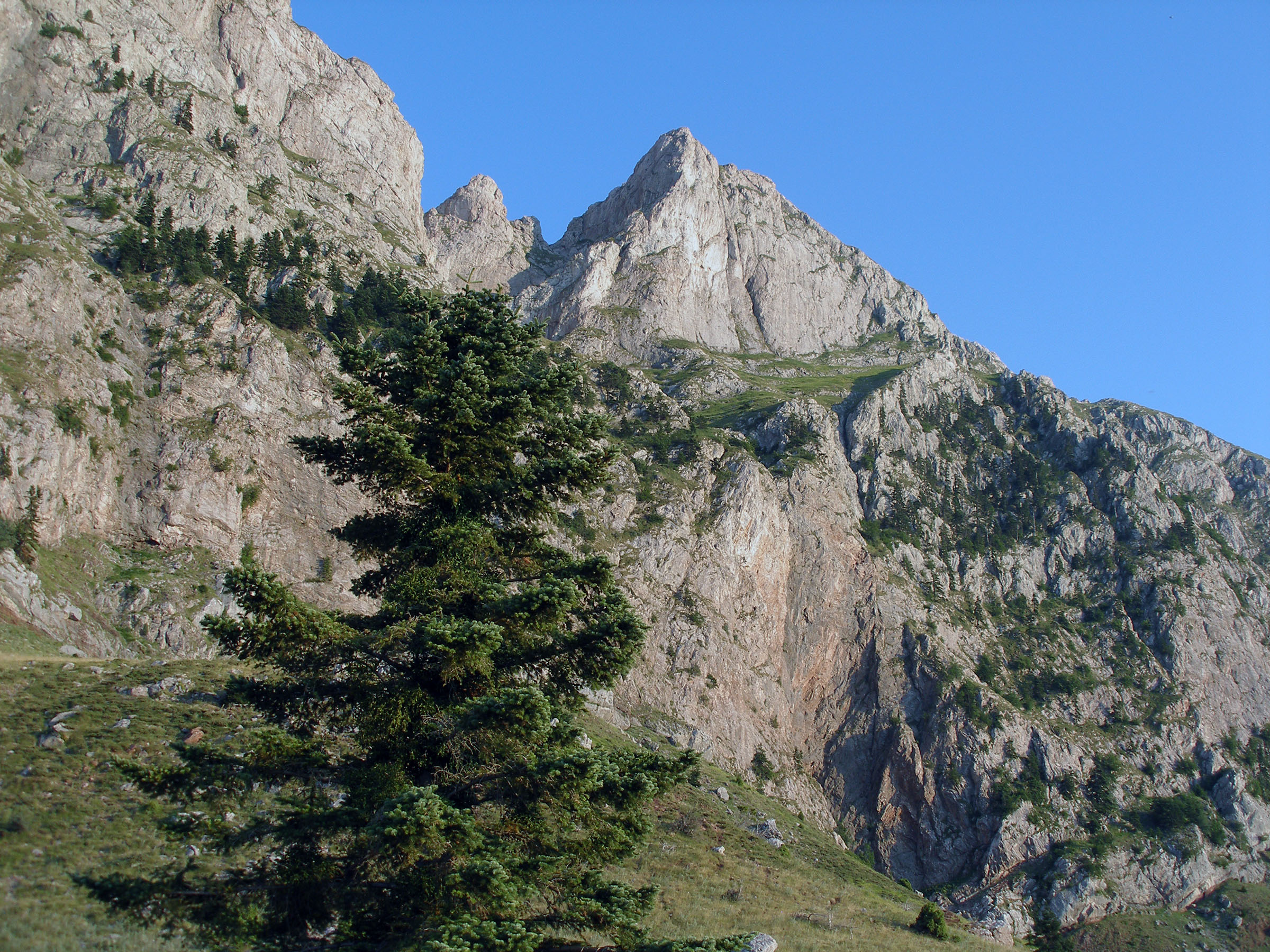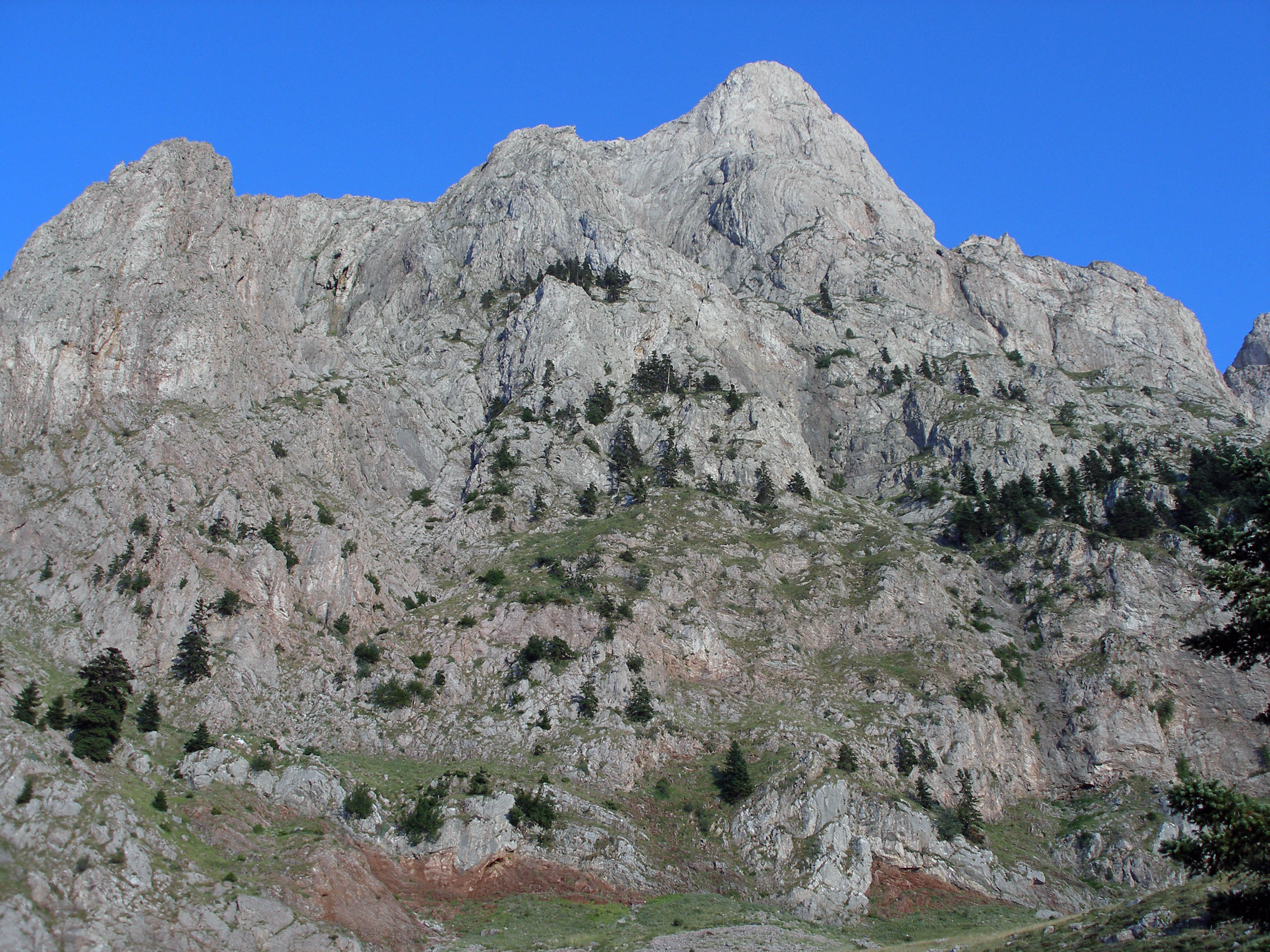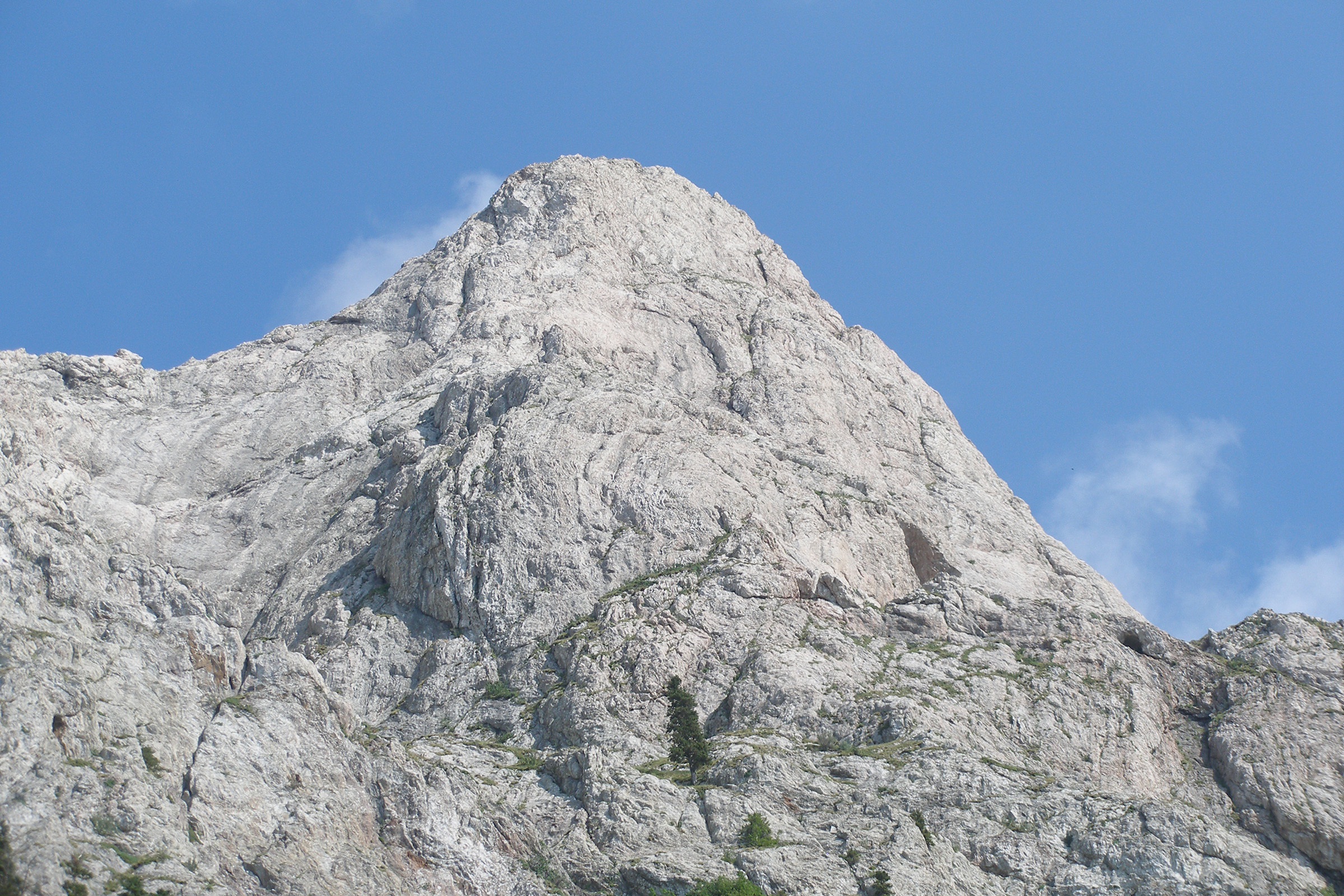
Pano Psilo (2160m) is a spectacular rocky precipice of West Vardousia, part of the Pano-Kato Psilo group, whose highest peak is Kato Psilo (2220m). Even though it goes unnoticed from Pitimaliko, Pano Psilo hosts the largest wall of Vardousia, which dominates the skyline across Artotina and glows beautifully during the sunset.
Pano Psilo offers exclusively rock-climbing routes, with traditional protection and an alpine character, on the massive northwest face, graded between IV and VI and of a height from 400m to 615m. Due to its orientation it is ideal for climbing in the summer and the rock is considered solid for Vardousia.
Between Pano and Kato Psilo, in the gully that separates them, even in summer, a stream of water flows, which when it increases in volume in the spring when the snow melts, creates the impressive Anemistos waterfall, 100m high. This water can be particularly useful for climbers who want to climb there.
In the ledges of western Vardousia, lives a population of wild goats (rupicapra rupicapra or chamois) which are beautiful and admirable, but can cause accidents as they run on the rocks and throw small or large stones.
Access
To climb on Pano Psilo, the most appropriate point of access is the village of Artotina to the west, with the approach made possible by the E4 trail or a dirt road.
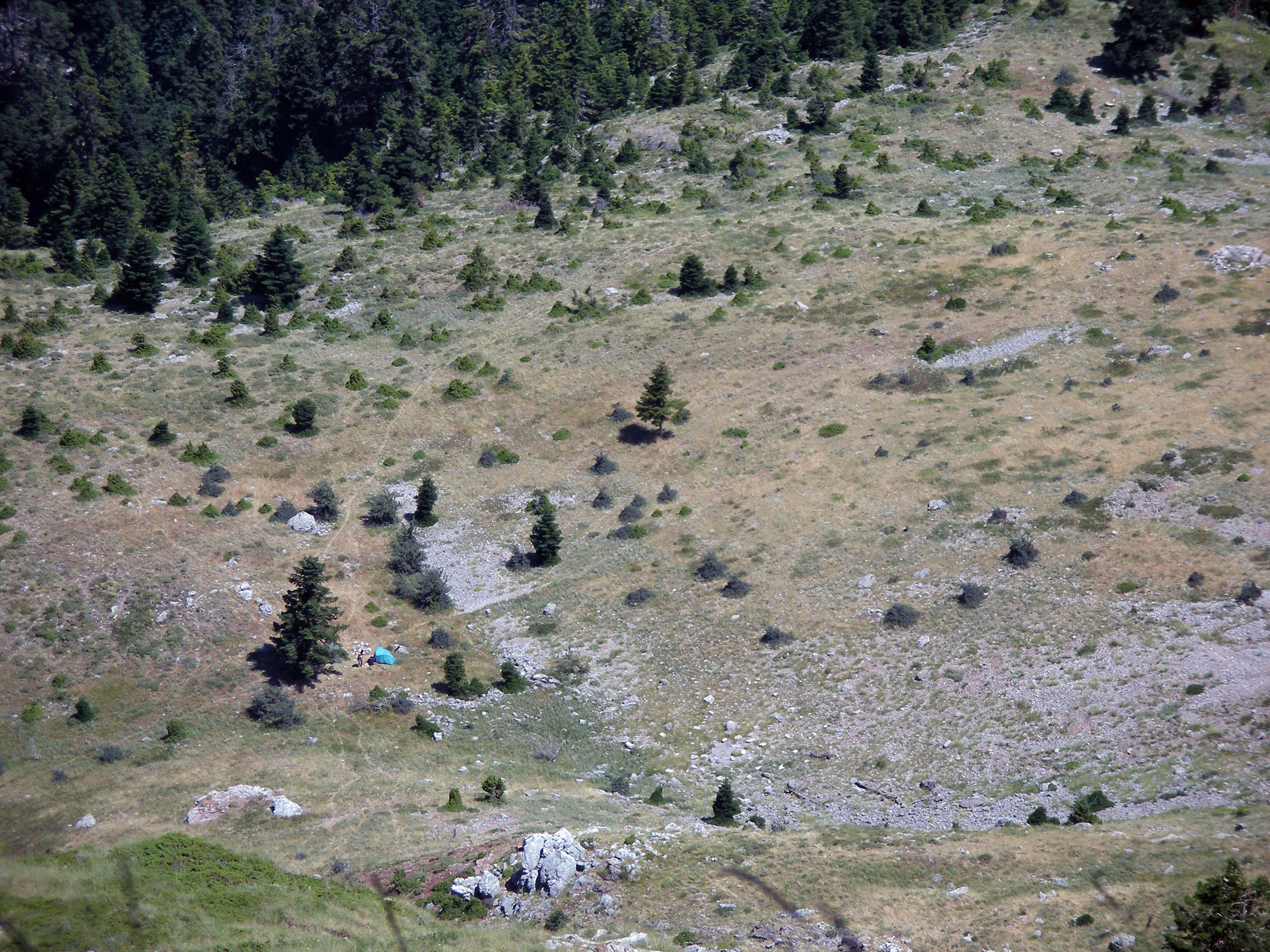
From Artotina we approach either by hiking, a distance of 7km and a duration of 3hr, or via a dirt road and a short hike on a wooded ridge lasting 15min, to finally reach the large clearing at the Koufolaka location, which is ideal for camping as there is a spring 400m northeast.
Access to the base of the routes from Koufolaka is initially done in a northeasterly direction and then, with an easy climb, we ascend to a sloping ledge, on which we traverse to the right, initially on a very narrow path, with an increased risk of falling.
The return from the summit is done by initially following the col that leads to the Pyramida and then descending to the base of Pano Psilo, using rappel where necessary.
In general, Pano and Kato Psilo are connected to the Plaka - Pyramida complex by cols and these cols are connected to each other by a path at the base of the western slope of Plaka. Therefore, to return from these peaks, in case of need, we can traverse to the base of Plaka in a southerly direction, to the Plaka - Alogorachi col, from where we easily descend to Mousounitsiotika Livadia and Skasmeni Strougka. Using the same path, we can traverse under the north side of the main peak of Kato Psilo and then head south to descend to the level of the large western ridge where, heading north, we will pass under Pano Psilo to finally descend to Koufolaka. In general, for safety reasons, it is good to have acquired a good knowledge of the hiking routes that cross them before climbing in the western Vardousia so as not to make mistakes on our returns. In the landscape of the western Vardousia, during the winter months when it is covered with snow, all accesses and returns change, while additional dangers appear, such as for example the very steep slope of the traverse at the base of Plaka, where a fall can be fatal.
Climbing history
G. Michailidis - D. Demestichas were the first to climb Pano Psilo, in the summer of 1966. The completion of their route (V, 400m) was revolutionary for Vardousia, skyrocketing both the maximum difficulty and height. However, these same factors led to the lack of repetitions, and as a result the specific topo of the route has been lost to time.
Climbers returned to Pano Psilo in July 1992, within the context of a climbing meet organized by EOS Xylokastrou and established four new routes with the contribution of A. Theodoropoulos, G. Sakkas, K. Tsitogiannis, K. Balamatsas, and G. Theocharopoulos among others. Meanwhile B. Tsoupras - N. Volgening had managed to complete their own route (VI, 450m) just a few days prior.
The zenith of efforts on Pano Psilo was the completion of “Harpy” (VI, 615m) by B. Tsoupras - G. Tzavelas in 1997, establishing the most emblematic big wall route on this coveted face.