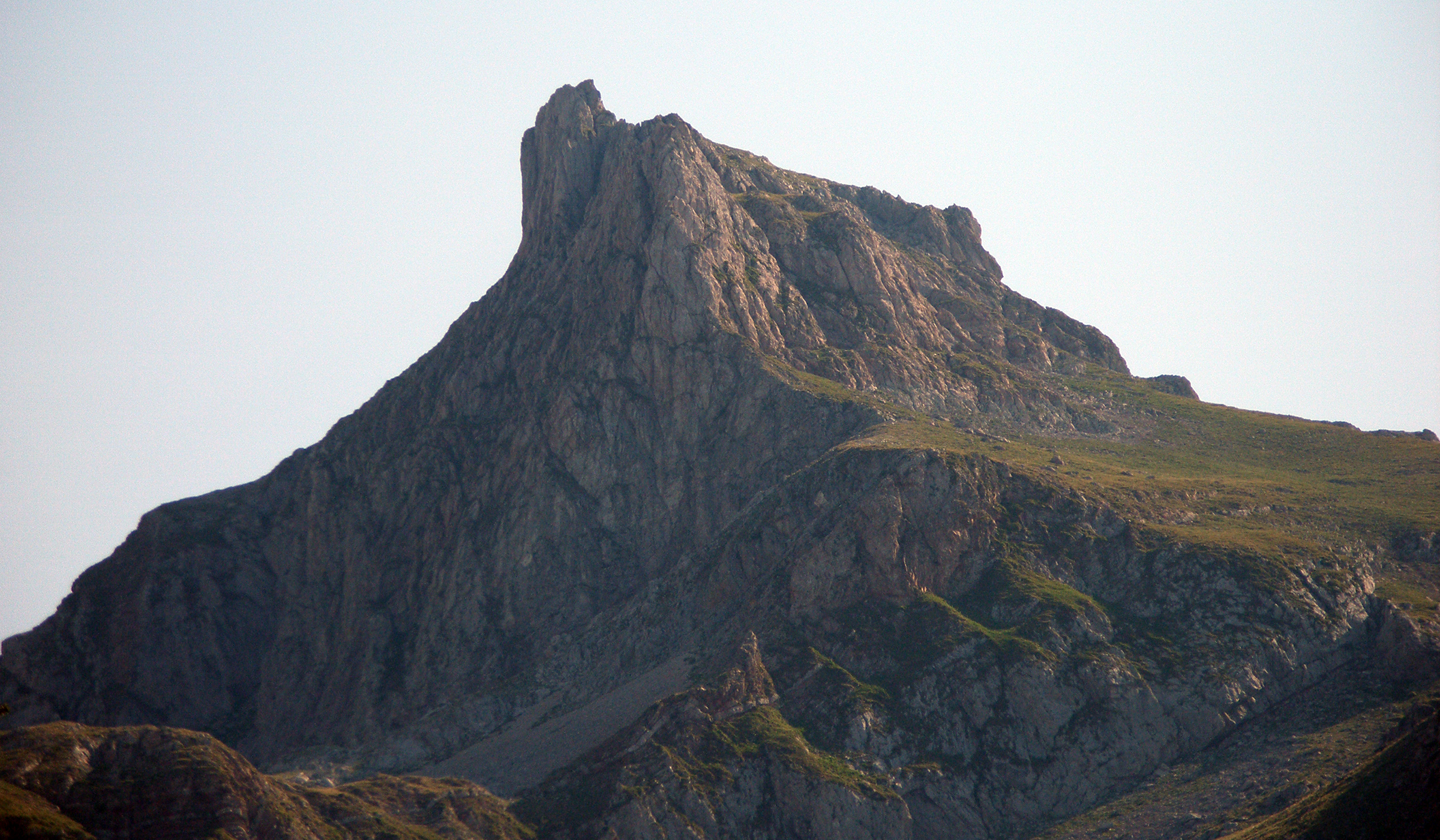
(Tou) Gkioni to Plai is the name of the characteristic and imposing rock formation which is situated north of the summit of Korakas (2495m), and west of the Koprisies plateau. Even though it hosts a limestone face of 250m in height, it is of increased interest in the winter since its exposure to northerly winds covers it in good quality ice, conductive to mixed climbing.
The name of the formation comes from the Eurasian scops owl (Otus scops), a small owl, which it resembles and which migrates to Greece in late spring, when the formation has lost its blinding cloak of ice and snow.
At Gkioni to Plai, initially only summer rock routes were established, but from the late 1990s onwards, interest in the crag turned to winter climbing of these routes, which offered medium to high difficulty on ice and mixed terrain.
From the 13 total routes, three are possible in dry conditions, with difficulties from IV+ up to V and a heigh of 200m to 250m, while the majority (10) are mixed routes, of difficulty from III M2 up to III+ M4 A1 and a height of 80m to 330m. Due its elevation the quality of snow and ice is usually good, but the eastern orientation requires morning climbing, before the sun warms the crag. The rock quality is described as very poor or bad.
Access
For climbing on (Tou) Gkioni to Plai the most appropriate point of access is the village of Agios Athanasios to the east, with the approach being possible also via the dirt road to the mountain huts (E4).
For the base of the routes, it is necessary to reach Koprisies, either from Profitis Ilias, or from the refuges via Skorda Pitimalikou, depending on the overnight stop.
From Profitis Ilias we follow the path (or the dirt road) towards the refuges, until we come across an iconostasis at the left side of the road. From there we climb the slope vertically, pass the first plateau and come out onto the second plateau, at the base of the crag. In winter we will need to climb a frozen slope up to 50°.
From the refuges, we can descend towards Profitis Ilias until we come across the iconostasis and from there climb to the base of the crag.
In total, we will need at least 1hr of walking to the base of the crag.
A shorter route from the refuges is not to go down too low but to traverse to the base of the routes in Skorda Pitimalikou.
The return from the exit of the routes to the base is done by descending initially to the west and then to the north, while to the shelters it can also be done by initially heading south to Megas Kampos and then west to descend from Portes.
Climbing history
1968 was an important year for alpine rock climbing in Vardousia and among others brought the first route on the crag, the “Michailidi - Proxanf” (IV+/V-, 200m). For the next 30 years this incredible face fell aside and only two enigmatic traditional rock routes were established during that period. Among these is the yet unrepeated “Vancouver ridge” (V-, 250m) by Chr. Papadopoulos - G. Kourtis - G. Chlorokostas - G. Stergiopoulos - G. Bonanos.
1998 brought a complete turn of fortunes for the face with the completion of the mixed route “Paranoid androids” (III+ 4 M4 A1, 200m) of by Chr. Belogiannis - D. Bourazanis - N. Chatzis, which follows the summer line of “Adamakopoulou - Makri” (V, 200m), opening the door for the development of more mixed routes on the formation. As a result, the next four years saw the establishment of six more winter routes of medium to high difficulty, from M2 up to M4+, and the achievement of the maximum height of 330m. These routes have become some of the most popular in Vardousia.
Warning: In winter, the slopes around Tou Gkioni to Plai present frequent avalanches if the conditions are suitable. Therefore, access there should be done very early in the morning and after we have made sure that the snow is stable and safe.