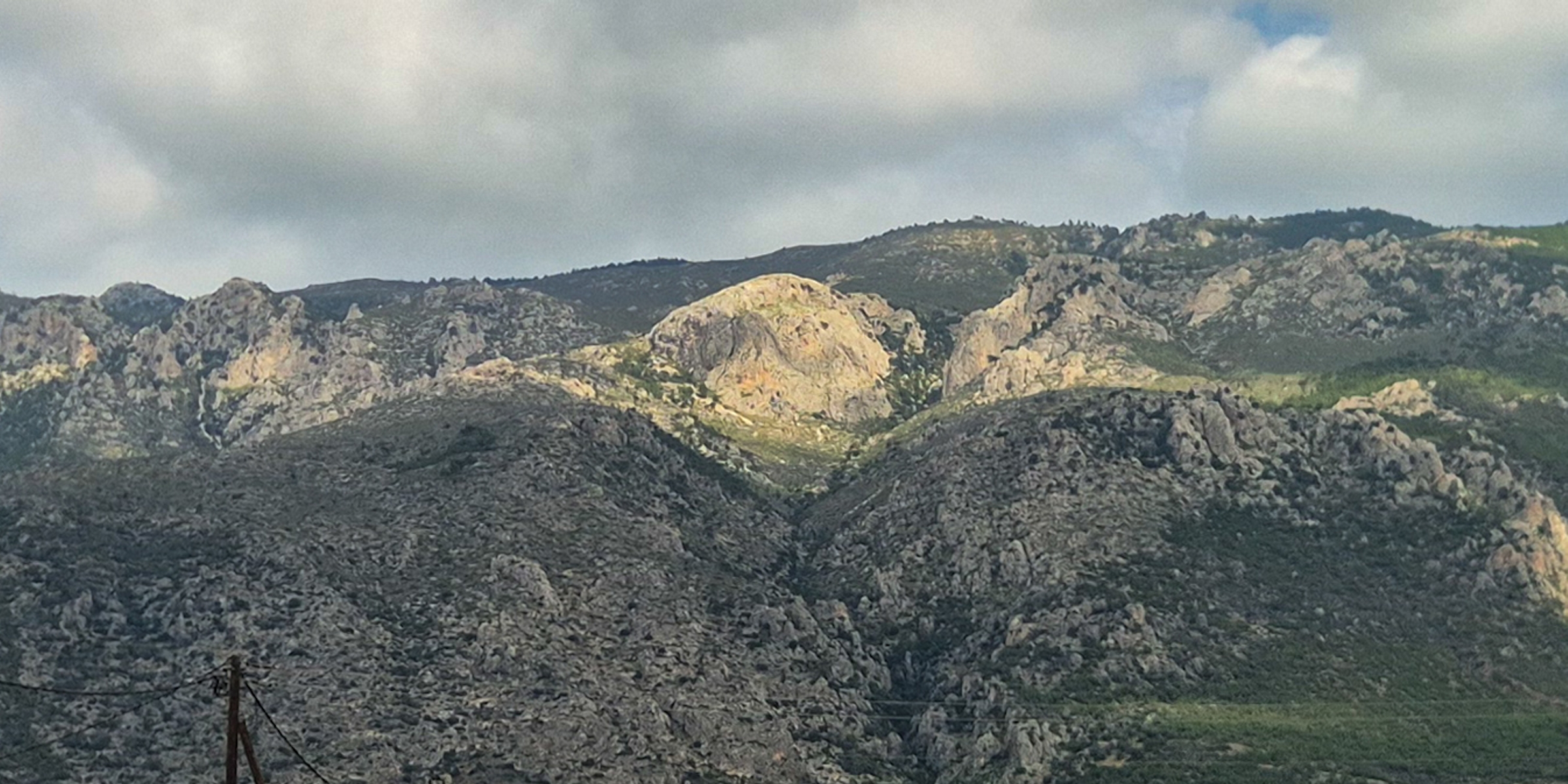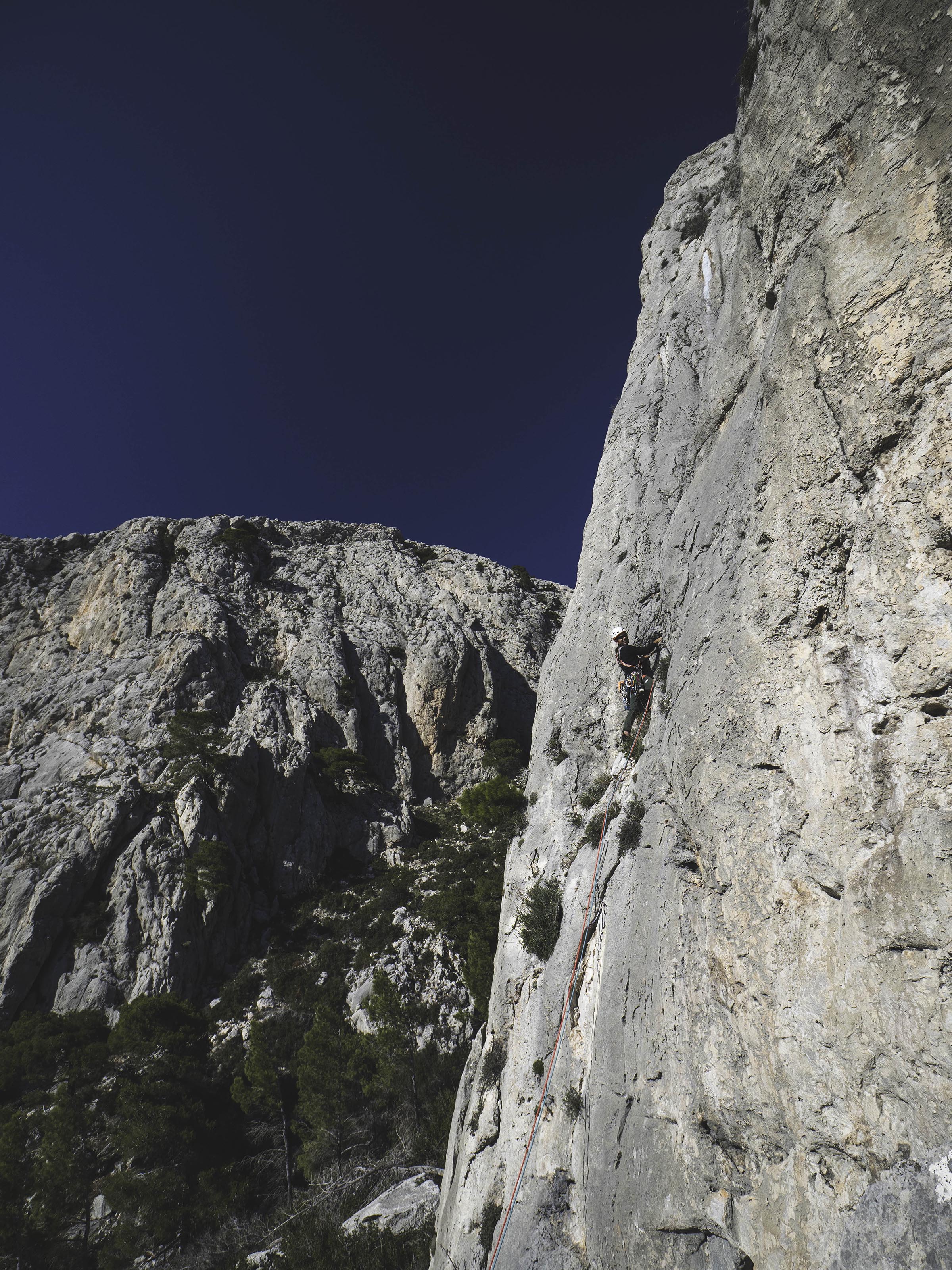
Paliovouna is a rocky complex on the south aspect of the massif of Pintiza (1032m), at an elevation of 650m, and the ravine which it forms flows into Loutraki. The complex of Paliovouna is composed of three sectors, the main wall Kentavros (southwest), the wall Dixalo (east), and the characteristic Paliovouna Tower (or Tower of Teo).
At Paliovouna there have been a total of 18 recorded traditional climbs with difficulties from III to VIII and a length between 60m and 300m; most of the routes are on the Kentauros wall. The orientation is primarily south, with the walls being orientated to the southwest and southeast, while the rock quality, at least on Paliovouna Tower, is very good. The belay stations on the tower were equipped by Nikitas Floros with permanent inox anchors which can be used for rappelling; no other bolts were added.
Access
To access the complex of Paliovouna, there are three options. First, according to D. Korres, we traverse the slope from Patapios monastery, but route is now destroyed by fires. A secondary alternative, again according to D. Korres, was the direct ascent using the ravine starting from Loutraki. Third, and finally, according to N. Floros, access is possible via a renewed trail which begins at an olive grove close to Profitis Ilias Monastery and which continues consistently uphill following a ridgeline and avoiding any burnt vegetation.
The descent from Paliovouna Tower is possible via the route “Ploumi - Gkeka”, with the arrangement of the anchors allowing the use of a single 80m rope to complete the rappels.
Climbing history
Paliovouna was the third area which was climbed in Geraneia. This occurred during an informal meeting between S. Antypas, I. Kanas, S. Diakogiannis, G. Tsamakidis, and T. Bakopoulos in May 1962, who completed routes on the two main walls of Kentavros and Dixalo. That July, Theodoros “Teo” Bakalopoulos would return along with M. Idosidis to climb the characteristic and robust tower.
The establishment of new climbs at Paliovouna during the 1960s focused on the low difficulties and medium height of the main walls, with the Tower of Teo, as it would be known, seeing its third new route in 1968. Then 1970 brought the fourth and final of the classic routes on the tower with “Ploumi - Gkeka” (IV+ A1 (VI-)). By 1976 new routes would cease to be added to the main walls too, as they were not offering a high enough difficulty for the climbers of the time. Years later, D. Korres would visit the tower and likely complete some of the first free repetitions of old aid cruxes.
The route “Synchronicity” (VIII, 60m) by N. Floros and A. Grapsas on Paliovouna Tower is a modern attempt to continue the tradition, half a century later. It is also the most difficult route at Paliovouna.