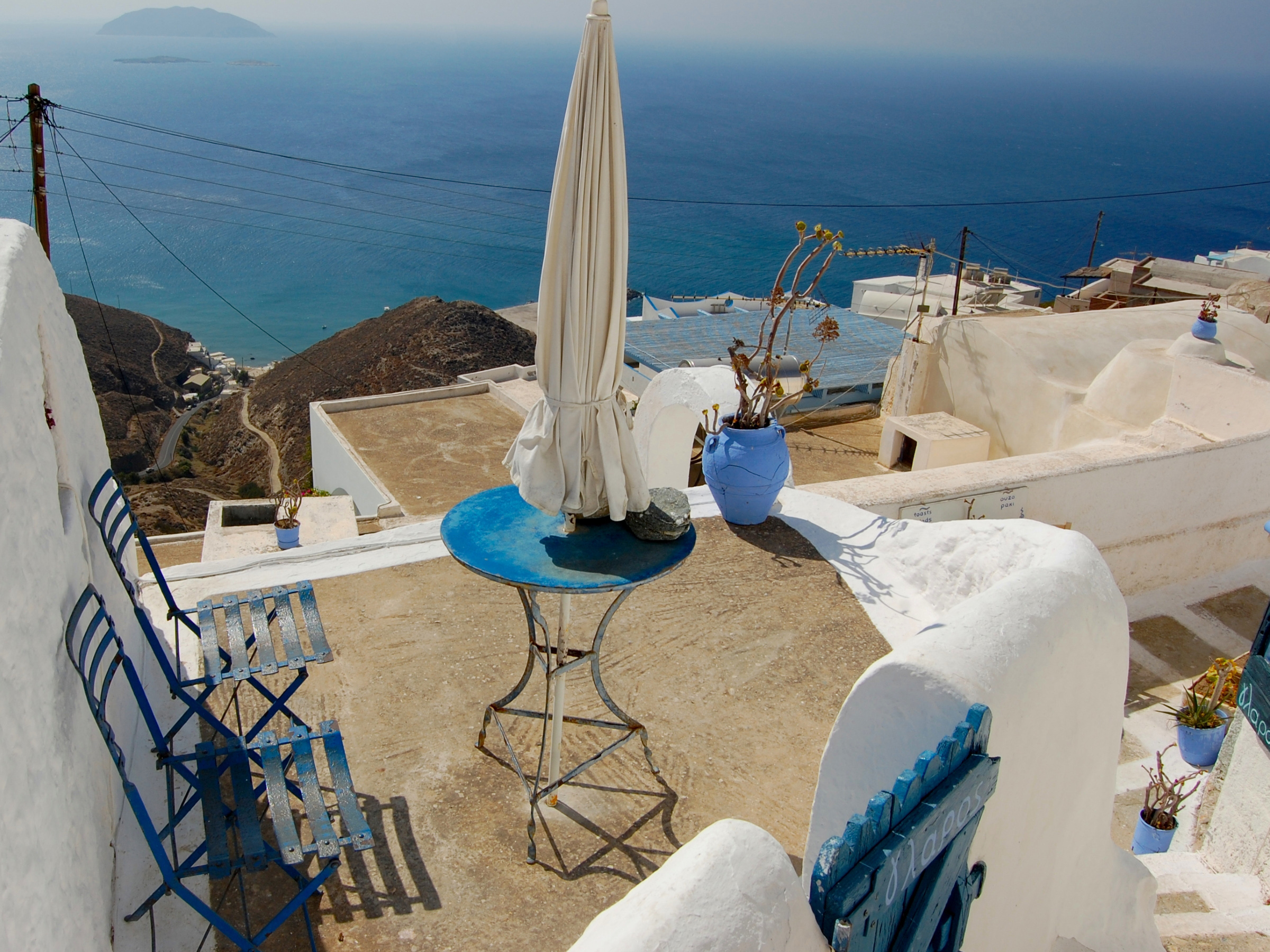
Anafi is a small island in the Southern Cyclades with fewer than 300 permanent residents. Located east of Santorini, it is defined by its arid, rugged, and rocky landscape. The island has only two inhabited settlements on its southern coast, while its highest point, Vigla (585m), rises northwest of Chora. To the east stands the striking monolith of Kalamos (470m), the largest in the Mediterranean.
According to myth, Anafi emerged from the sea at Apollo’s command to provide refuge to the Argonauts. Its name derives from the ancient Greek ἀναφαίνω (anaphaino), meaning “to appear” or “to shine”. The island was inhabited during the Hellenistic era and later came under Venetian rule for nearly three centuries. During the Greek War of Independence, Anafians joined the revolutionary struggle; many later migrated to Athens, where they worked as builders and established the picturesque neighborhood of Anafiotika beneath the Acropolis. The island was electrified in 1974 with the installation of a generator.
On the north side of Kalamos lies the Dragon’s Cave, an impressive cave with a spout that exceeds 10m high and inside there are beautiful stalactites, stalagmites and golden-green deposits. Access to the cave is only via a rough path and is inaccessible from the sea. Locals believe that its chamber extends along Kalamos with an exit to another smaller cave on the south side of the monolithic rock.
Access
The island of Anafi is accessible only by ferry, mainly from the port of Piraeus but also from Santorini. Anafi is a remote island and thus has limited scheduled ferries during the winter months, only two to Piraeus and two to Santorini per week. During the summer, there is near daily connectivity. Since ferry schedules often change, especially during winter, it is recommended to confirm details with the local port agent before traveling.
Routes overview
Climbing on Anafi is defined by the towering monolith of Kalamos. Its rock, featuring a mix of limestone and marble, deeply sculpted by marine erosion, offers routes that are predominantly traditional, fitting the wild and untouched character of the island.
Emblematic is the route “Argonaut expedition” (V, 250m) by Aris Theodoropoulos and Thomas Michailidis, which was completed on 20/6/1999 and follows the south ridge, visible from Chora. Two more significant routes followed; the sport route “Halcyon” (7b, 435m) by Aris Theodoropoulos, Giannis Torelli and Nikos Chatzis in 2008, as well as the traditional route “The ritual of hardship” (7b, 500m) by the international team of Konstantinos Andreou, Kyriakos Rossidis, Andreas Rossidis, Daniela Banc and Jenny Schauroth.
Beyond big wall routes, bouldering problems graded between 5b to 6c/c+ can be found near the New Monastery of Zoodochos Pigi Kalamiotissa. Further development potential exists both on Kalamos and in the granite formations of the island’s western side.