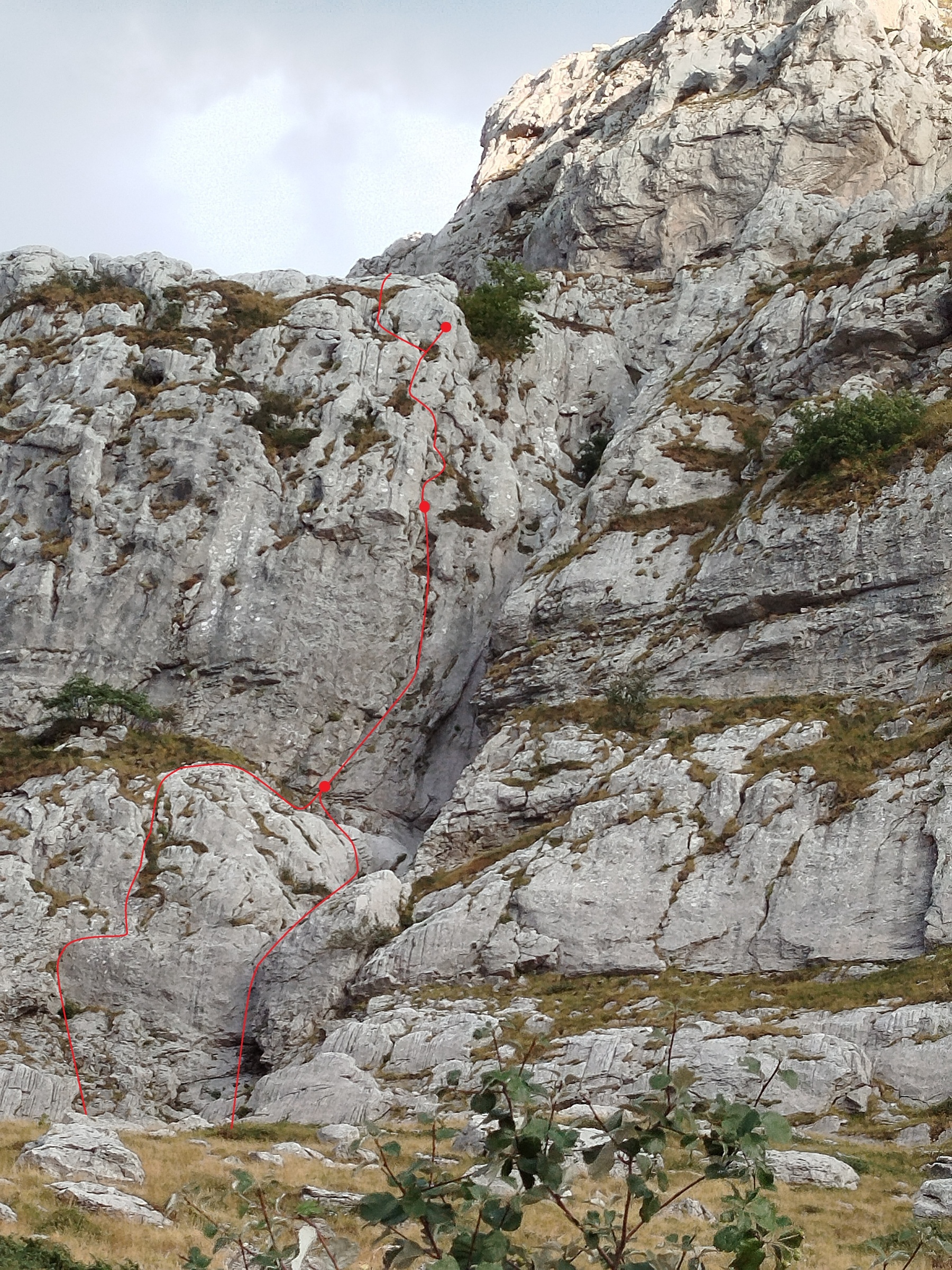
The route “Physicist's gully” (VIII-, 170m) was first ascended on 13/9/2026 by D. Giounis - K. Sfyris.
The line is located in one of the distinctive gullies on the northwest face of Astraka, within the first rock band, below the first major terrace.
During the first ascent, D. Giounis free-climbed the crux at the 2nd pitch (VIII-), but due to a lack of time, the difficult section of the 3rd pitch was left as an aid-climbing section. On 23/9/2026, a very cold day, D. Giounis returned with D. Gerolympos and repeated the route, establishing a variation named “Technocrat's slab”, that included a new, more difficult 1st pitch. Additionally, D. Gerolympos flashed the 2nd pitch and free-climbed the aid section of the 3rd pitch, assigning it a grade of VII+/VIII-.
For the 1st pitch (V+, 45m), we start up the distinctive gully with easy moves to reach a slab (V), which offers good protection, and emerge onto a smooth, positive-angled slab; from there, traverse right to a ledge. There, we will find a small chimney (IV+) leading to another ledge, and finally, we follow the inner part of the gully up to easy, grassy terrain (III). To the right, we will spot a bolt and a piton (R1 of the “Kleo” route), continue left up a tight chimney (V+), passing a piton, which leads to a ledge, where we set up the belay using a piton and cams.
For the 2nd pitch (VIII-, 25m, VII- obligatory), we continue up from the belay station onto a positive slab featuring a crack (VI), well-protected by a nut and a cam, until we reach a bolt. From there, we proceed up a slab with a crack (V) to find another bolt slightly higher up. To our left lie very loose blocks that must be avoided; instead, we move right onto a small ledge, leading to a slab (VI-) equipped with a bolt. Next, we tackle a short, overhanging traverse (VI+), protected by a bolt, that leads rightward onto a smooth, overhanging arête, culminating in an overhanging dihedral. This section constitutes the route's crux; it is protected by three bolts and rated VIII- overall, requiring sustained movement on small, smooth holds and footholds. Upon completing the crux, we exit into a small chimney, protected by a small piece placed in a through-hole, to move past the chockstone blocking the exit, using dihedral moves (V+), and continue to a small ledge in a recess beneath a chimney, where we will set up a belay on two bolts (which can also be used for rappelling).
For the 3rd pitch (VII+/VIII-, 25m, VI+ obligatory), we continue above the belay station with a difficult, localized move (VII+/VIII-) on friction and mediocre holds; this is protected by a bolt, which should ideally be clipped using aid techniques, to prevent an accident involving the belayer in the event of a fall. From there, we traverse right to a piton and make a localized move (VI+) on a slab, leading to easier terrain that can be protected with a cam. Continuing up a small, tight dihedral, we encounter a bolt protecting an awkward move (VI+) that leads to a positive slab beneath an overhang. We then traverse left (VI), protecting the move with a small friend, to reach a small ledge. We continue upwards, placing a cam and a thread for protection, and encounter a bolt protecting a V+ move; this leads to a grassy ramp that brings us to a ledge, where a two-ring anchor is located on the right.
For the 4th pitch (IV+, 25m), we continue left along a positive crack (IV+) to reach easier, positive terrain, where we set up an anchor using pro.
From there we will continue for 50m on an easy terrain (II/III) until the ridge.
For the first pitch of the “Technocrat's slab” variation (VI+/VII-, 45m), we start to the left of the gully on a positive slab (IV) that leads to positive, grassy terrain (III) beneath a small chimney. We carefully enter the chimney (IV+), watching out for loose blocks, and place cams for protection. After clearing the chimney, we move right onto the slab toward a poor piton (V-); we place a nut for protection and climb up to a small ledge (V). There, we will find a bolt and face a sustained VI+/VII- sequence that ends at the top of the slab; protection beyond the bolt is provided by a thread and cams. From there, we exit onto easy, positive terrain (III) and continue to the R1 anchor of the “Physicist's gully” route.
To repeat the route, we need two 60m ropes, a set of nuts, a set of cams, and 10 quickdraws. The quality of the rock is generally very good.
The approach takes about 40min from the refuge. We first descend towards the Krouna spring, then we leave the path and head towards the gully.
To return from the route after reaching the ledge, we have two options. The first option is to head right, cross two gullies, and find an exposed wild-goat trail, that leads to the base of the sheer face at the far right; from there, we finally reach the start of our route by moving left parallel to the rock face (40min total). The second option, is to head left, crossing gullies and negotiating short rock sections (up to IV), to reach the “Meniscus” tower and then the refuge (50min total). Another option is to stop at R3; from there, two rappels, the first from the route's R3 and the second from the R1 of the “Kleio” route, (R3-R1 55m, R1-R0 30m), allow us to reach the base of the route.
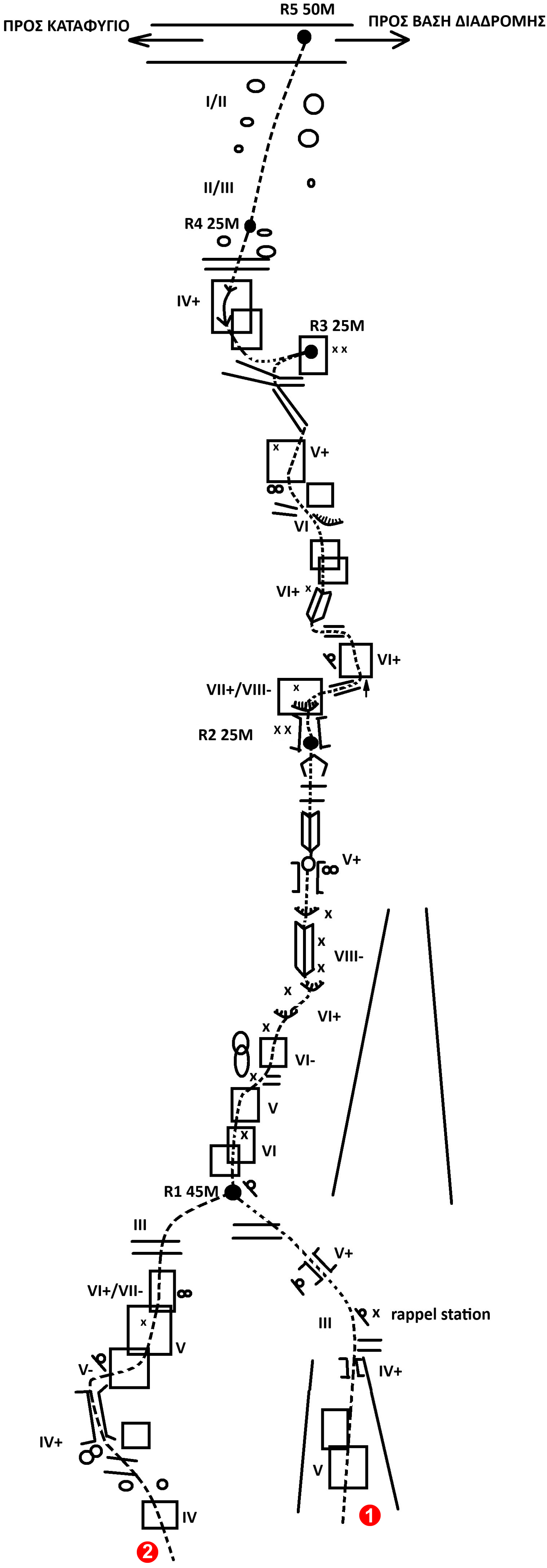
Sketch of the route where [1] “Physicist's gully”, [2] “Technocrat's slab” variation.
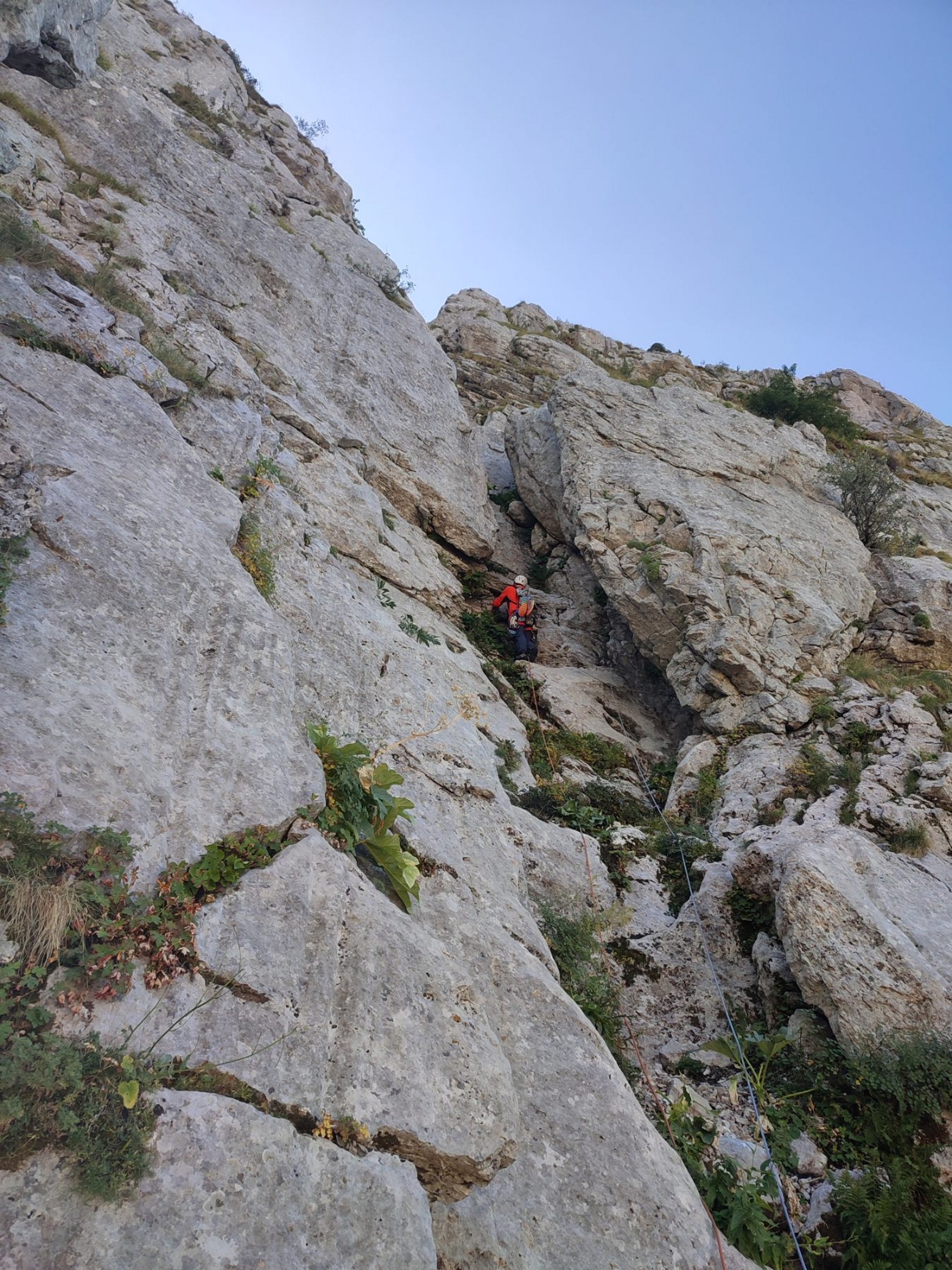
At the 1st pitch gully.