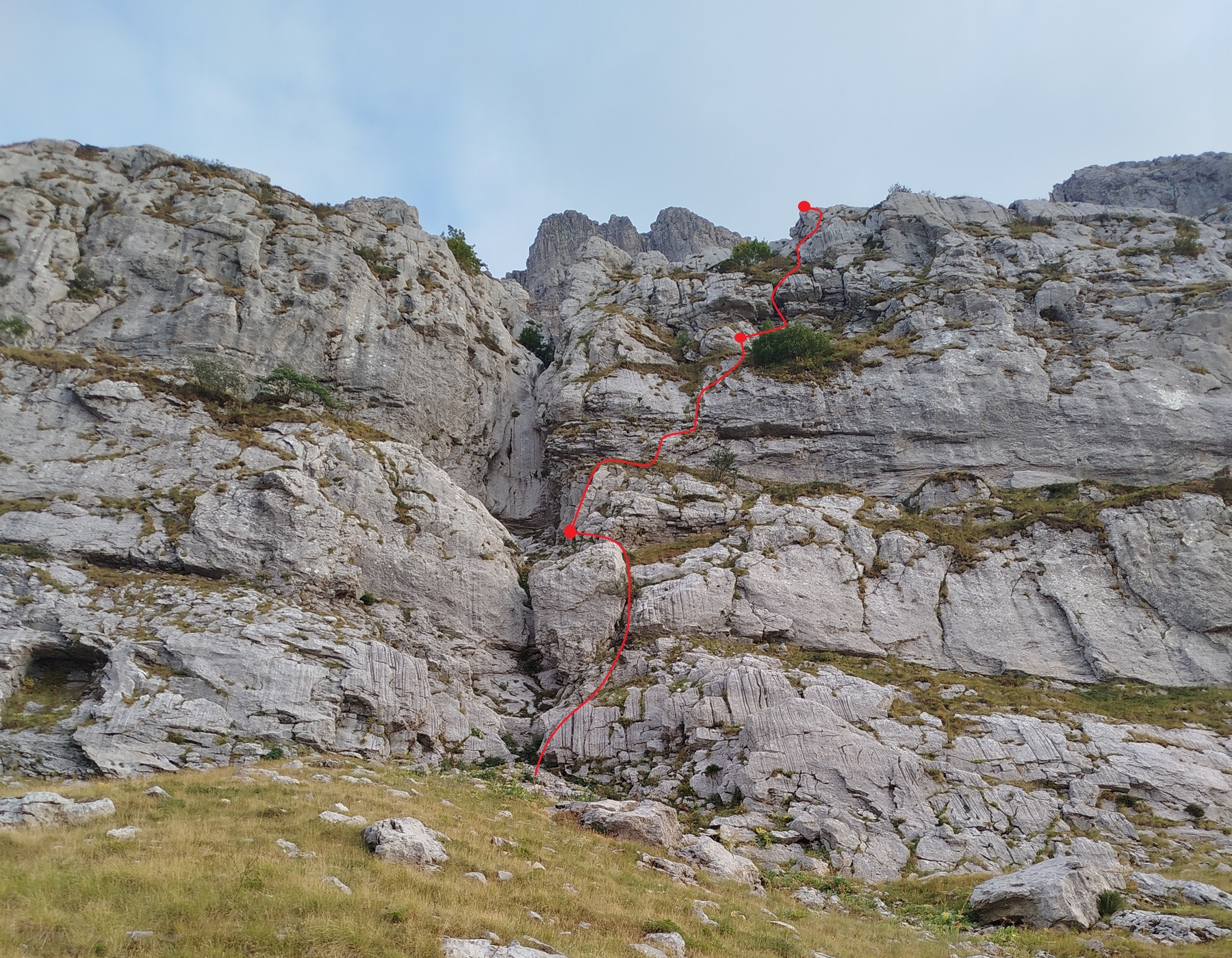
The “Kleio” route (VI+, 170m) was established on 19/9/2026 by G. Arkoudas - D. Giounis.
The route lies within one of the characteristic gullies on the northwest face of Astraka, in the first rock band below the first major ledge.
The line was created as part of an effort to establish traditional routes featuring organized belay stations and a few bolts in run-out sections, aiming to make this face of Astraka, where the rock is exceptionally solid and the climbing highly enjoyable, more accessible.
For the 1st pitch (V, 35m), we start to the right of the gully on easy terrain (IV) until reaching a dihedral, with a slab to its right, that leads up to a tree. After climbing the dihedral (V), which offers good protection at its base, we use the tree to move onto a smooth, positive-angle slab, then continue up a smooth dihedral (V-) that leads to a ledge inside the gully on easy terrain (III). From there, we continue a short distance upward to a belay station consisting of a bolt and a piton (which can also serve as a rappel anchor).
For the 2nd pitch (VI+, 35m), we continue up and to the right from the belay station over relatively easy terrain (IV+), placing cams for protection, eventually exiting left onto a small ledge that leads to a slab on the right. Just a few meters into the slab, we find a piton; we move up a short distance to reach a bolt and execute a difficult move (VI+) using small crimps. From there, we traverse right (V+) to place protection in a good crack, then continue further right with a move (VI) that leads to a positive-angled slab featuring a bolt. From the bolt, we continue upwards, place a cam (Camalot #4), reach another bolt, and proceed rightwards between sections of upright, grassy slab involving continuous climbing at the VI-/VI grade. At the end, we find a bolt at the start of a grassy ramp; the entry is difficult (V), but the rest is easy, leading to a ledge where we set up a belay using a bolt and a piton (which can also serve as a rappel anchor).
For the 3rd pitch (VI+, 50m), we move right past a small tree to enter a chimney (V); shortly after, we encounter a piton and continue until we reach a ledge. From there, we proceed with an overhanging move (VI-), well-protected by cams, to enter another chimney, followed by a second overhanging section (VI+) that is very well protected by a large thread placement. After the traverse, we emerge onto a small ledge and find a bolt protecting a move up (V+) over smooth rock and grass, leading to a positive, grassy slope. There, we encounter a small chimney with a smooth, positive slab (V) and finally reach a ledge with a piton. From the piton, we continue rightward across a well-protected slab (IV+) and set up a belay at two bolts with rings.
From there, to reach the terrace, we continue for another 50m across easy, grassy terrain (II-III).
To repeat the route, we need a set of nuts, a set of cams (Camalot #4), and optionally, a few pitons and a hammer. Although there are bolts in sections where the rock offers no natural protection, the route retains a traditional character, with most sections requiring the use of trad gear.
The approach takes about 40min from the refuge. We first descend towards the Krouna spring, then we leave the path and head towards the gully.
To return from the route after reaching the ledge, we have two options. The first option is to head right, cross two gullies, and find an exposed wild-goat trail, that leads to the base of the sheer face at the far right; from there, we finally reach the start of our route by moving left parallel to the rock face (40min total). The second option, is to head left, crossing gullies and negotiating short rock sections (up to IV), to reach the “Meniscus” tower and then the refuge (50min total). Another option is to stop at R3 and descend to the base of the route via two rappels using the belay stations of the route (R3-R1 55m, R1-R0 30m).
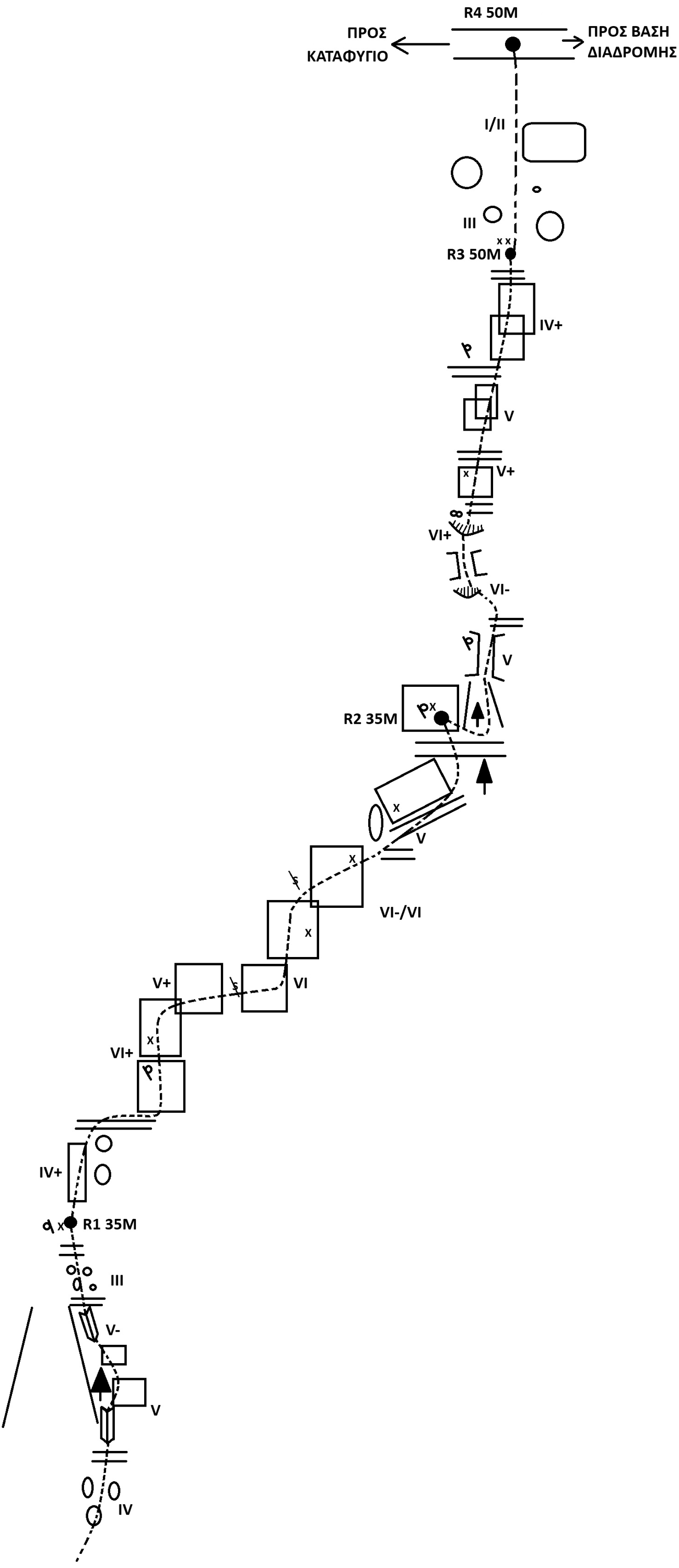
Sketch of the route.
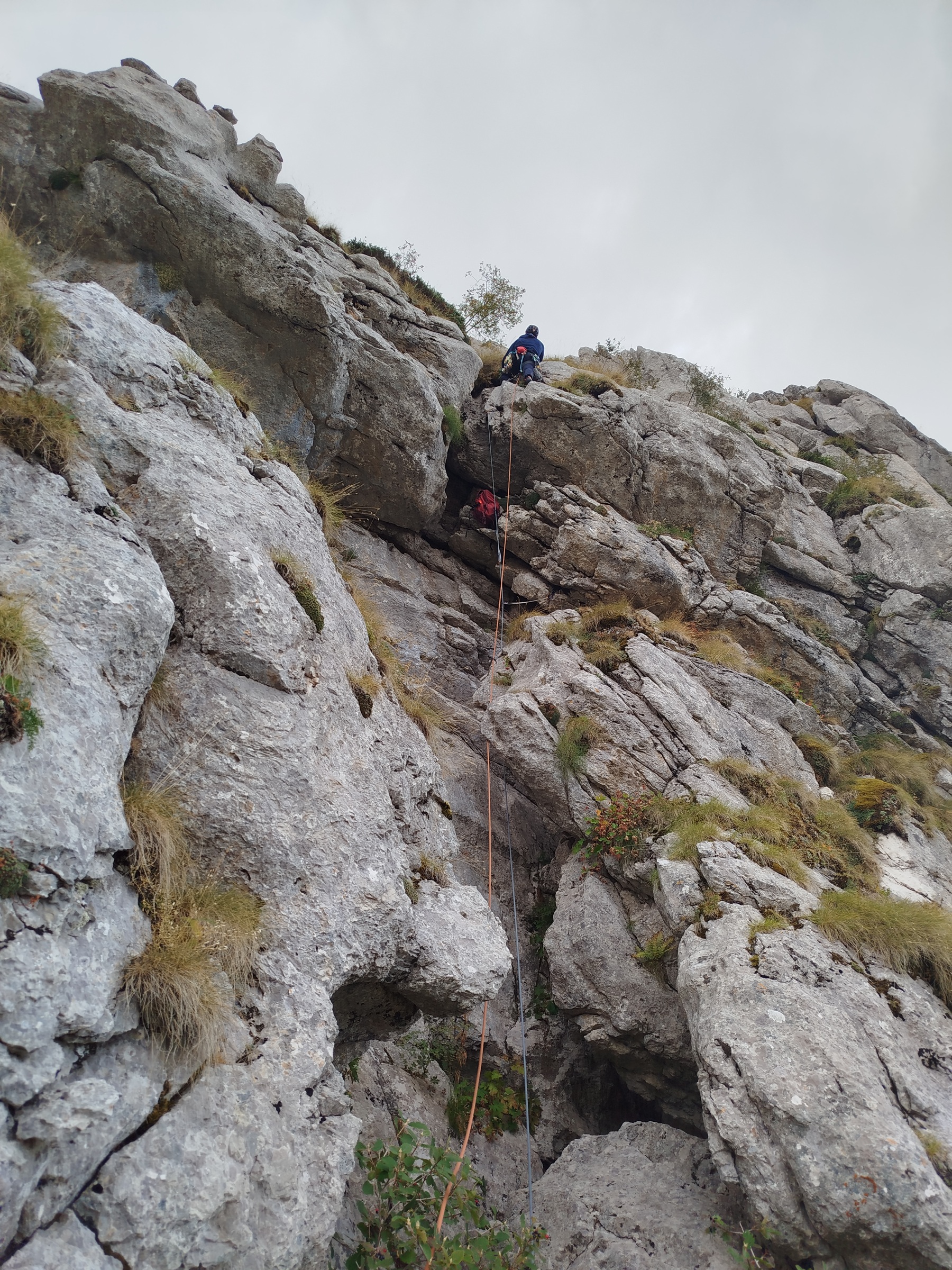
The 3rd pitch.