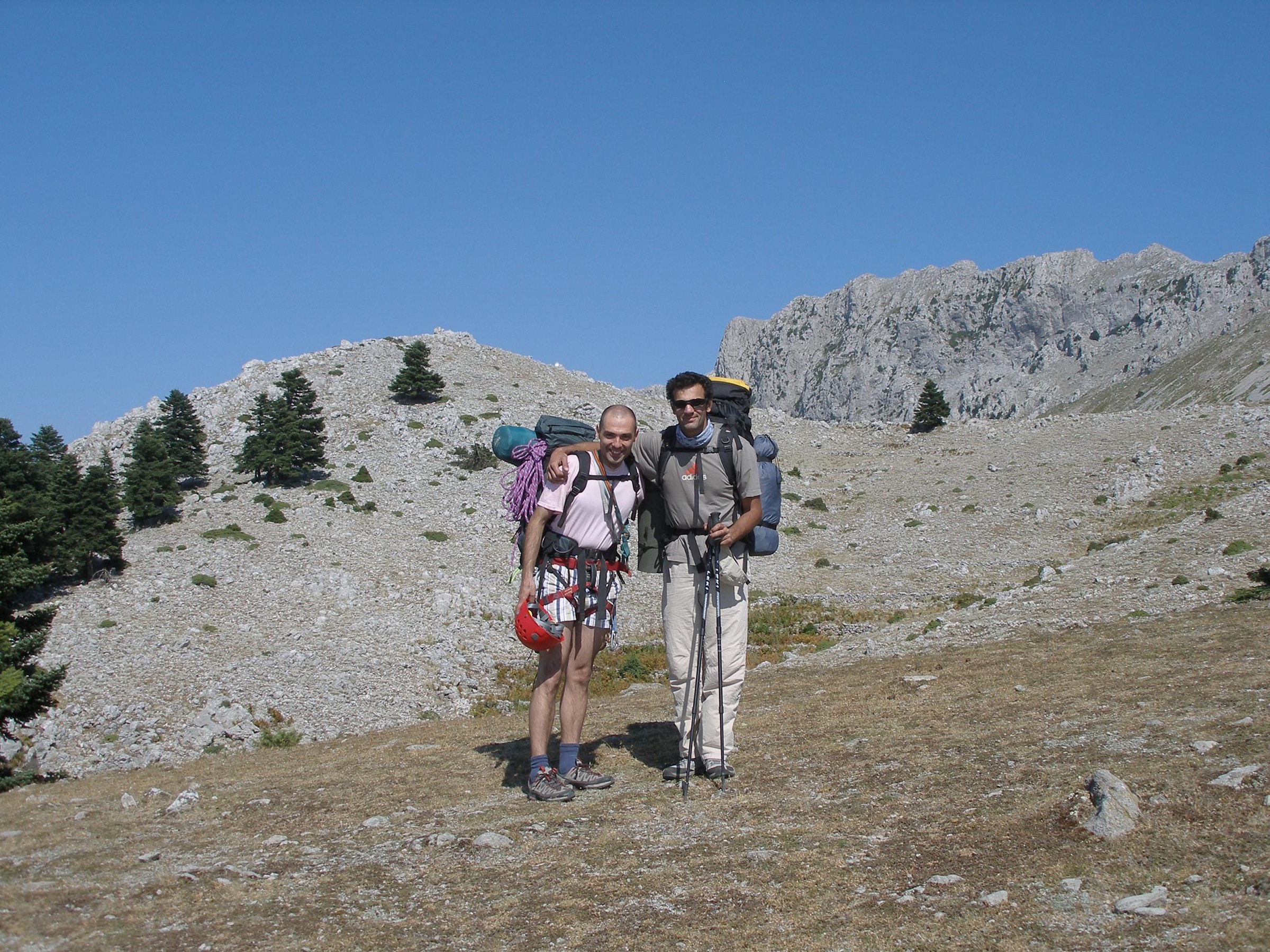
The first ascent of the route “Druna” (VII A1, 245m) was realized on 29/7/2007 by D. Karalis - D. Aivazidis.
The first repetition of the route was realized on 19/6/2008 by A. Konstantinidis - K. Stefanoudakis.
The attempt for this line, at the face of Xerovouni, which has been forgotten over the last 30 years, started in 2002 but the route was finally finished in July, 2007. The first ascent was realized the traditional way, from bottom to top, and it was equipped with permanent protection (bolts) which were placed only at passage of VI+ difficulty rate or more. The line offers an impressive view to the Aegean See, Sporades, Peak Dirfy, Halkida and Attica. Due to its orientation, the route is ideal for the hot months, since all pitches up to R5 are covered with shadow until 15:00 and at the rest of the pitches, the sun is not particularly annoying either.
The 1st pitch starts with difficult (VII) climbing technique in an overhanging crack and it continues with a vertical palm crack of continuous difficulty (VI+) until the belay. The 2nd pitch follows a slab (VI+), then an aid passage (A1) and finally a move (V+) to get on a ledge with trees until the belay. The 3rd pitch follows a vertical dihedral (VI+) with an overhanging exit (VII-) and after that a slab (VII) followed by a slightly exposed traverse, which brings the line to the belay. The 4th pitch goes straight up on a vertical slab (VI+) and then follows an aid climbing passage (A1). Next, the route moves on a left, long traverse (VI+) followed by an exit (VI+) via a distinctive open gully until the belay, equipped with a bolt. This traverse must be equipped for the follower as well, with nuts and slings. The 5th pitch continues up to the right, on a ramp-dihedral (V+) until the belay. The 6th pitch initially goes slightly to the right, through the bushes, and then enters a crack-dihedral (V+) that moves up and slantwise to the right and finally ends where the little trees are. The pitch continues by following a crack that starts on an unequipped black slab (VI), somewhere in between these little trees. At the end of this crack, the line traverses to the right so as to get into a big dihedral (water-groove). The belay is set somewhere inside this dihedral. The 7th pitch continues with a very beautiful dihedral (V+) that leads out to the light, on a sloping ledge with impressive view, where the belay is set. The 8th pitch goes straight up (III) and then slantwise to the left into a very beautiful dihedral (V) without trees, that leads to the top for the belay.
In order to climb this route, 13 quickdraws and 10 slings as well as a set of nuts, a set of friends (or excentrics) and 2x50m ropes are required. Optionally, one could be equipped with a few pitons and a hammer, just in case. Bear in mind that after R5 there aren’t any pieces of permanent protection or fixed belay stations.
The approach to the route is possible via Dirfys’ col, by following at first the dirt road that leads to Xerovouni. After 500m approximately, to the left, there is the footpath that leads in about 2 hours to the base of the central face. The line is found at about 50m to the left of the characteristic “funnel” of the face, 240m high, which is visible not only from Dirfy but also from the beginning of the path. An alternative way of getting there is to take the road leading to Stropones village and, at the turn where this road meets the gully that comes down from Xerovouni, follow the footpath that goes up along the gully. This choice of approach will give an alpine style to the whole venture and will ensure a faster return.
In order to return down from the top, walk leftwards (east) and then, after the end of the crag, descend to the base; this will take about 1h. Escape possibility is offered until R5, by abseiling from R5, R3 or R1.
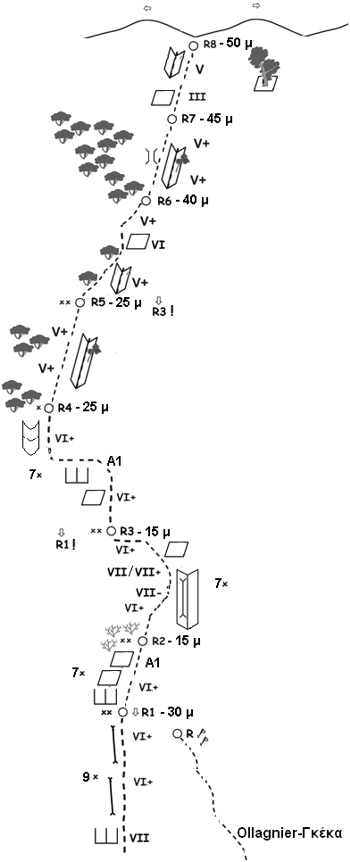
The route.
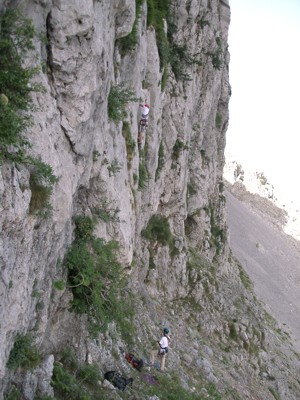
D. Aivazidis belaying D. Karalis.