The first ascent of the route “Dietrich Hasse” (VII A2, 310m) was realized on 2/6/2024 by V. Galanis through solo climbing and the use of protection gear (rope solo).
The route begins at the base of the left crack of the small pillar attached at the base of the tower. Besides a sloped negative wall on the sixth pitch, it can be climbed free by a strong rope team.
The line is well equipped with permanent bolts on the difficult sections, but additional removable protection is needed. Specifically, apart from the permanent bolts which require quickdraws, some large nuts, some friends (Camalot #0.5 - #4), hexentrics (#9 - #11), two modified skyhooks for 10mm holes or a clipstick for the A2 sections of the sixth pitch are necessary.
To access the base of the route, drive to the Church of the Meteora Fathers in the eastern part of Kalambaka. From the monastery, continue straight by car for 180m until you find a dirt parking area. From there, a dirt road leads towards the tower for 50m. At the end of this road, there is a left trail which we follow. When we reach below the tower, we do not continue on the trail; instead, we leave it and ascend for about 50m to the route’s base, where a chemical bolt acts as an anchor on the ground. It takes approximately 25 minutes walking to reach the route’s start.
In addition to the main route, V. Galanis opened two variations:
- “The easy way” (VI+, 20m), opened on 18/10/2022 by V. Galanis via solo climbing with protective gear.
- “The second way” (VI+, 55m), opened on 19/10/2022 by V. Galanis via solo climbing with protective gear.
To access these two small variations, take the road to the Monastery of Agios Stefanos. 250m before reaching the monastery, there is parking on the right, where we leave the car. From there, follow a very clear trail leading to the top of the tower. We come across a small wall that can be scrambled easily, and then continue along the crest for approximately 100m. We reach a second scrambling section that brings us to the summit. There, on the left side, there is an obvious belay with two bolts, which marks the start of the “Second way.” Carefully moving to the right, you will enter a shallow cave, and towards the end of this cave, you will find a belay with two bolts, marking the start of the “Easy way.”
The Dietrich Hasse
Dietrich Hasse (24/3/1933 - 19/4/2022) was a prominent climber who not only left an indelible mark on European climbing overall but also, together with Heinz Lothar Stutte, was the creator and organizer of the highly significant Meteora climbing area. Not only did he develop this extensive “climbing park,” but he also ensured it was connected to a specific style of climbing and route opening (“from below”) with minimal protection and without intervening in the landscape. Ultimately, he and others who shared this philosophy taught Greeks how to climb difficult cracks using only natural protection, creating routes that are still legendary and pose a challenge even for advanced climbers today.
The Kapelo tower
The Kapelo tower is massive and imposing, located in the eastern complex, right next to and on the right side of the Kalambaka Tower. It is featured in the center of the cover photo of the first guide by Stutte - Hasse.
Before this route was established, the Kapelo tower had no complete routes, although many had considered it, and Bernd Arnold attempted it years ago. Additionally, someone possibly climbed the right crack from the small pillar attached at the tower’s base in the early 1980s, where some bolts were found in the crack and at the top of the pillar.
In a ledge below the summit, two half-inch self-drilling bolts were found, which were likely installed during the filming of James Bond’s “For your eyes only” in 1980, which features several scenes from this summit.
Since the summit of the tower is accessible from the back via scrambling, and thus may be reached by non-climbers, the summit book was placed 1m before the end of the wall to prevent it from being seen and to avoid falling into the void while trying to reach it. There is a belay at the top, along with a separate belay for the book, so that someone can secure themselves while signing it.

The route drawing at the Kapelo tower.
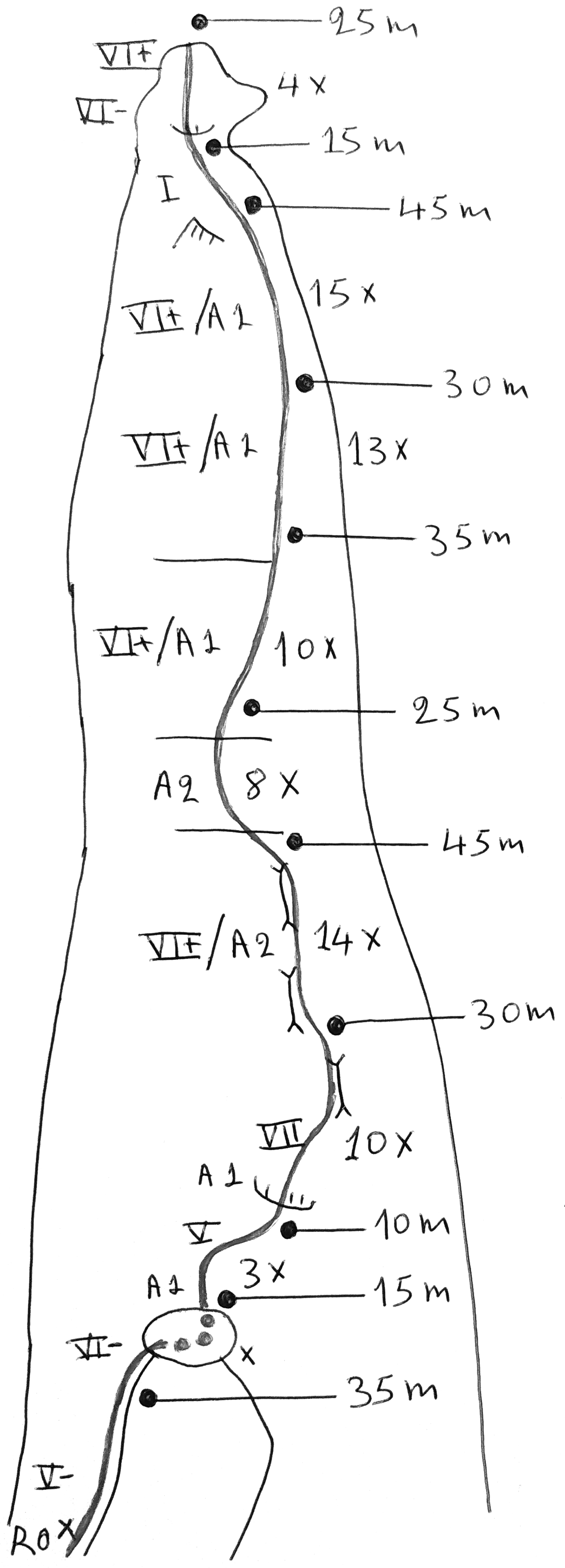
Sketch of the route.

The two variants. “The easy way” on the left and “The second way” on the right.