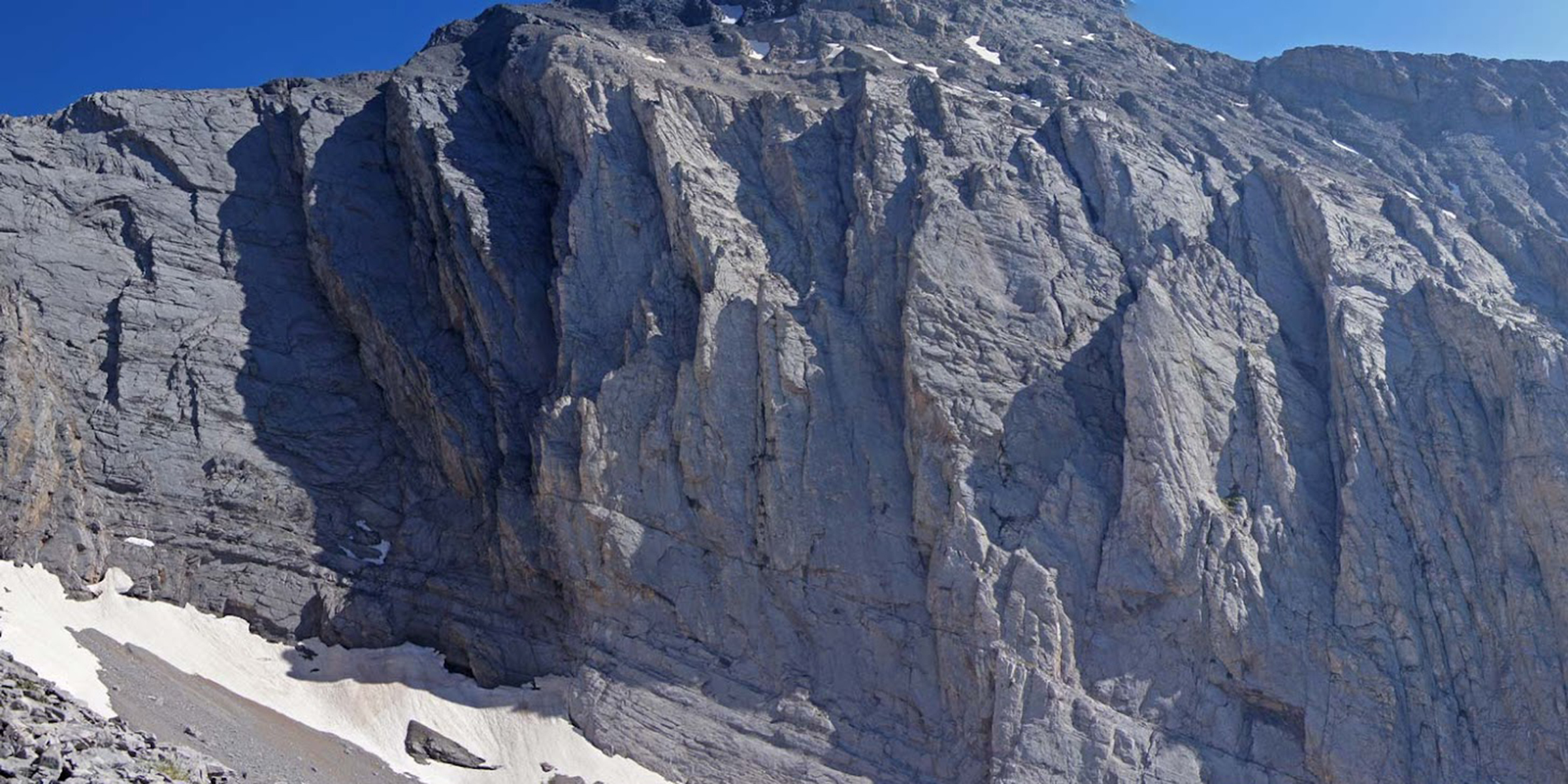
Skala is the col between Mytikas and Skolio and is part of the Skolio ridge, of which it is essentially the southeastern end. It is known for the “Kakoskala” pass, which leads to the top of Mytikas, following a route with many natural “steps” in the rock, which gave the location its name (from the latin word “scala”). This name was first mentioned by M. Kurz in 1923, who gives its highest point at 2866m, but with modern methods (GPS) it has been measured at 2875m. Although it is not a regular peak of Olympus, its highest point is often referred to as “Skala Peak”, and is mainly used as a place name and reference point, due to the high traffic it has from those who want to climb Mytikas from there.
As the col of Skala to the north drops steeply, it forms a crag, between the imposing massif of Mytikas and the great “wall” of Skolio. This crag, which is not particularly extensive, is referred to in some reports as part of Skolio, in others as an independent crag of Skala and in others as “Zerf’s slab”. The latter name is used exclusively by climbers, because in its center was established in 1964 the route “Zerf - Arvanitidi”, a route that is particularly popular today.
The separation of the crag of Skala from Skolio may not be entirely correct, but it has prevailed in many descriptions. However, it sometimes causes confusion since E. Eleftheriadis, in his book “Olympus: Climbing Routes 1930-1978” (1978 edition), places “Zerf - Arvanitidi” in Skolio, while in Skala only mentions one route, the “Botteri - Natsi”. The same is adopted by N. Nezis in his book “Olympus - The Mountain of Gods & Men” (2019 edition). According to these references, “Zerf - Arvanitidi” is not in Skala but somewhere in Skolio. However, it is most likely that when the route was established, it was initially published that it belonged to Skolio, considering the crag as part of Skolio.
It has therefore become common to consider the Skolio crag as independent and to often refer to it as “Zerf’s slab” because of “Zerf - Arvanitidi”. The crag has acquired its own dynamics, since it has relatively easy access, is lower than the neighboring ones and also has an easy return.