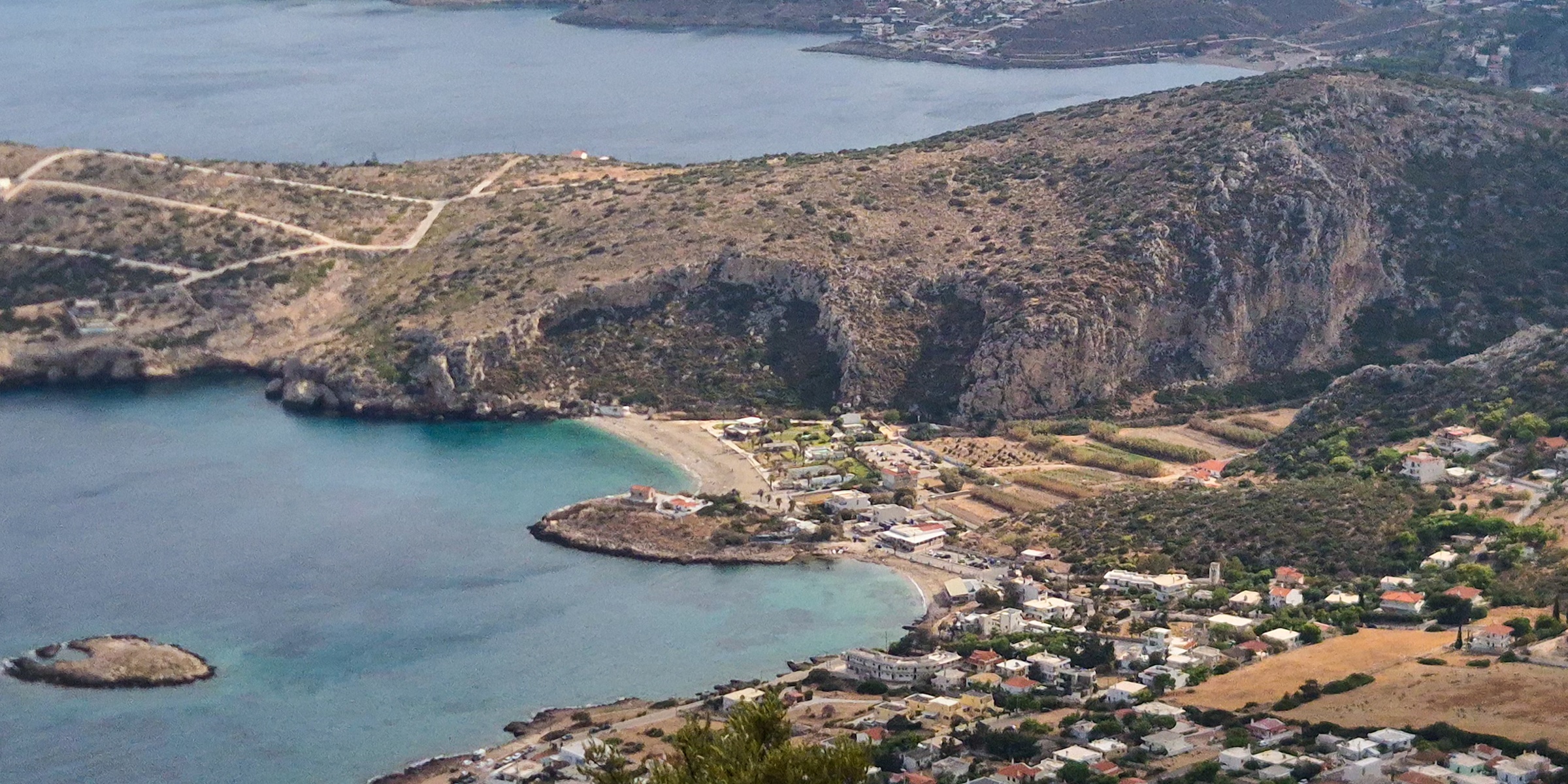
Kakia Thalassa is a seaside settlement near Keratea in southeast Attica which developed as a holiday destination and today is one of the most popular beaches in the area. The town is situated in the shadow of Oros Mavrinora or Mavroneri (405m), which forms Cape Tsourgeli (or Cape Mavroneri) to the north, and to the south borders with Cape Aspro (or Aspri Pounta). The beach has not been developed besides seaside activities, with a few monasteries, and framed by thick pines.
The name “Kakia Thalassa” is derived from mythology as it was said that Poseidon and Hades defended the Greeks against barbarians by sending large waves which sunk their fleet nearby.
Kakia Thalassa crag is ideal for climbing year-round, excluding the hottest summer days, as its northwesterly orientation offers shade until the afternoon. In total there are 30 routes, four (4) of which are traditional, with difficulties from 4c to 8a+, a height between 8m and 70m, and all are equipped with two-point closed anchors. Most routes are between 6a and 7b making the crag ideal for intermediate climbers, while the rock quality is surprisingly good.
Access
The approach to Kakia Thalassa is achieved via EO89 Leoforos Lavriou, and exits either before the Keratea industrial zone, or Keratea itself, and then continues the rural road to Kakia Thalassa. Reaching the settlement there are multiple parking options, some of which are free. To reach the crag, we walk across the beach to its end and turn right at the characteristic ravine. We follow the ravine initially on its cement riverbed, then continue a trail, for a total of 350m. The crag is on our left-hand side. The total access time from the beach does not exceed 15min.
Climbing history
Kakia Thalassa is one of the oldest climbing areas, with its first six (6) routes completed in the late 1970s and its official designation as a “crag” dating to 1978. A landmark achievement was the first ascent of “Crack” (VI+, 20m) by D. Korres and Th. Avramopoulos. Further route development was pursued by K. Kladis, N. Psaltis, P. Iordanis, E. Kirkos and D. Stravogenis.
The year 1991 was particularly significant, as L. Giannakoulis and C. Belogiannis completed “Stegi” (VII, 15m), one of the first successes in the 7th grade. At the same time, visits by G. Potamousis, D. Xanthopoulos and E. Karampelas led to the bolting of difficult sport routes in the “Spilia” sector. Between 1998 and 2001, S. Moutzouvis and D. Stravogenis undertook the major task of modernizing the crag by adding many routes and replacing protection.
In 2012, the crag underwent full maintenance to HFMC standards under the guidance of D. Stravogenis. Existing protection was replaced with stainless-steel resin bolts and anchors, with no additional bolts installed. Th. Grasos, K. Kiziridis, Th. Tsoumanis, G. Kagiaftakis, G. Oikonomou, K. Politis and G. Karnakis also contributed to the effort, with equipment provided by the HFMC. The “Spilia” sector was not maintained.
In 2024, the crag was renamed “Stefanos Moutzouvis” in recognition of his contributions to the development of the area.
Due to the proximity of the crag with sea water and its equipment in 2012 with SS304 bolts, as well as after the relevant research conclusion on bolt-failures at a nearby crag (Daskaleio), it is recommended to avoid this crag.