The rock of Petra at the foothills of mount Parnitha is one of the oldest and most important climbing spots in Greece. Actually, the first climbing school in Greece took place in these rocks back in year 1928. Since then many things have changed but the rocky outcrops of Petra are still a popular climbing venue especially for beginner Athenian climbers. It is remarkable that despite the popularity of the place, the routes do not suffer from polishing thanks to the excellent rock quality.
Being a historical place for Athenian climbers, the rocks of Petra and the nearby multi-pitch walls of Flampouri have generated controversy among the local climbing community regarding the style of climbing that should be practiced there. Today, many of the old routes have been bolted mainly to be used as practice ground for climbing schools according to new sport climbing ethics. Other are still preserved in their pure traditional form and fiercely protected to remain this way. Such routes often bear remnants of the past, in the form of old rotten pitons from the first ascents. Some of them have painted numbers on their base that correspond to the old numbering system. To avoid any confusion in the tables below, the old numbers has been provided along with the new ones marked in parenthesis, e.g. route 10 (31).
Because of its historical significance and the premium of its location (on the foothills of Mt Parnitha with splendid views over the city of Athens) the rocks of Petra certainly worth a day’s visit even if your climbing skill exceeds the “old-fashioned” technical difficulties the rock has to offer. There are almost no routes above 7a-7b, overhangs are scarce and roofs are non-existent. However climbing here has a certain very distinct charm, one noticed even by the famous Walter Bonnati who proclaimed that he “would be a happier man if he had such a rock face back home” during his visit in the early 60s.
For the access to the field, exit Attiki Odos, on Exit 8 (or 8a) for the National Road (direction to Lamia). Stay on the National Road for about 5Km up to the signposted exit to Thrakomakedones and the Olympic Village. Leave the National Road following the signs to the Olympic Village. Turn left at the traffic light just after the exit in order to cross the bridge over the National Road. Continue for 5Km, passing at some point the main gate of the Olympic village on your right hand. At the end of the main road (point A on adjacent map) turn left on the traffic light, pass the first crossroad and then immediately turn right to M. Alexandrou Street. Stay on M. Alexandrou as it goes uphill and changing names first to Thrakis Street then to Thessalonikis Street and finally to Veroias Street. 4.5Km from (A) reach school building on your left hand and turn right to Edessis Street (mark B) opposite to the school. Continue to Edessis for about 1Km where it changes name to Kozanis Street. At this point you have reached the end of the Thrakomakedones settlement where the characteristic rock outcrop of Petra can be seen nearby. Park here (bus stop of bus 724) and continue on foot through clearly visible footpath to the crags.
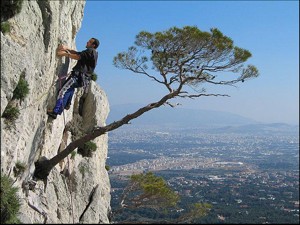
D. Apostolakos climbing route #22.
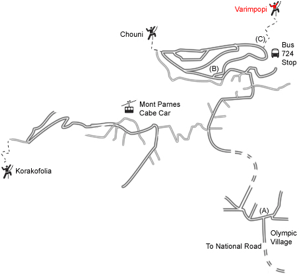
Access to the field.